butterpaper

A quarter century has passed since the towers fell. Too busy working on this site to be watching the late night news, I had no idea until I cycled to work the next day. No one got much done, we were in a state of disbelief. I wrote this stiff little piece that day, a more reflective one the next week, and another one or two as the tortured rebuild progressed.
Then there was that bloody war in Iraq, which had me so annoyed I built a short-lived website about what was wrong with it, and became an early member of Architects for Peace. On the 10th anniversary I had a look at the memorials in 2010. Not sure why I’m sharing this, other than it has been on my mind today. It was a pivotal moment, a prelude to worse times, and it was from the year I really started to write. I noticed that these old posts had become disconnected so have put them back together here.
11.09.26
Wellington City boasts an enviable location, nestled tightly around a sheltered port on a harbour that curls in from the ocean. It’s a dense and lively city with streets painted on the side of rugged hills. Constrained on all sides, it has a compactness that is central to its charm but a bane for traffic engineers concerned with shunting people in and out efficiently. After a decade of stymied attempts to improve the city by improving its public transport, cycling and walkability, the current government has ditched all that and replaced it with a plan for a wider and faster road.
There is one ugly duckling of a street that I’d try to miss on my visits, without ever thinking about why, it was just unpleasant to engage with. It’s one of the worst affected by the State Highway 1 (SH1) “improvement” plans. Vivian Street is one of a thicket of narrow streets but unlike others it runs in a gun barrel straight line, east-west across the city. This quirk is the cause of its gradual undoing. In this post I’ll follow the street from its beginnings right up to the current confused proposal. The next post will look at the complex bigger picture.
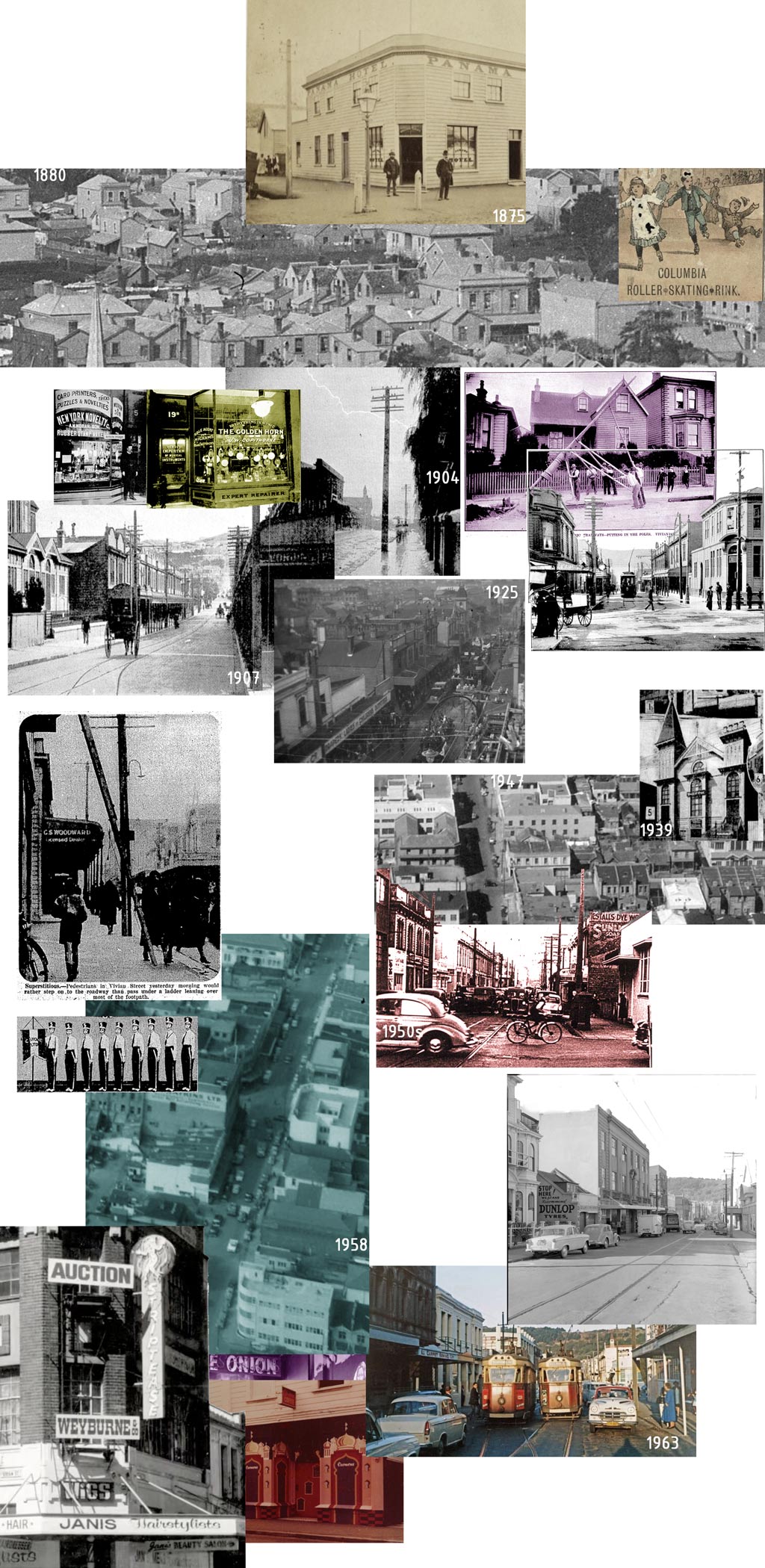
Vivian street composite
28.06.26
The Art deco style turns 100 this month. Sort of. But what was it then, what is it now, and how did it become associated with architecture?
Architecture wasn’t really welcomed into the “deco” stable until 1974, when the Finch College Museum held a dedicated exhibition, “American Art Deco Architecture”. It had a mission – to save numerous at-risk 1920s skyscrapers from demolition or pillaging… by art deco enthusiasts.
28.04.25
How things don’t change. From 2007: “The housing affordability ‘crisis’ is one example of a reduced debate. The parties can’t open their mouths about ditching negative gearing or calming skyrocketing house prices without alienating great swathes of the electorate. The affordability debate is restricted to suggesting new ways to top up the wallets of first home buyers, new ways to lower building costs, empty promises on interest rates, and to pressuring state governments to rezone land at the edge of town for new homes.”
15.04.25
Pedestrians are suffering on the road more than they should be because of a gap in jurisdictions. Vehicle safety is the priority of road safety authorities. Traffic flow is the priority of traffic engineers. Pedestrians are difficult moving targets. Their manufacturers never update their safety features, and they are prone to unexpected changes in direction.
16.03.25