Melbhattan from Oslo Davis on Vimeo.
I recently watched cartoonist Oslo Davis’s Melbhattan. I wondered, from the awkward Anglo-Unami title, whether this might be a reflection of Melbourne’s spruikers’ predilection for magnifying the tiniest evocations of foreign places found in our midst. Come to Melbourne and imagine you’re in New York, Paris… anywhere but Australia. But Davis says he was trying to ridicule this mindset in his film, “to both charm and roast without being mean”. It is a charming piece of work. The roasting doesn’t quite eventuate, probably because Davis was recreating in Melbourne each shot of the brilliant opening sequence to Woody Allen’s “Manhattan”, using locations here, so didn’t have a lot of room to move.
“Manhattan” – Opening Scene from ajr on Vimeo.
Not that New York hasn’t ever borrowed from the cachet of another place. In 1962 urban planner Chester Rankin christened the area south of Houston St “SoHo”. The reason for the name sticking is probably to do with its close resemblance to Soho in London, which in the ’60s became the swinging place to be thanks to Carnaby Street. Melbourne developers like naming after New York. It’s easy to find blocks of flats with names like ‘Madison’ and ‘Manhattan’. There’s even a ‘Tribeca’ even though it is not in a TRIangle BElow CAnal Street.
South Jersey (NJ) borrowed and transformed SoHo into SoJo. Now areas in Collingwood are becoming known as SoJo (South of Johnston), and NoJo (I’ll leave you to guess that).
The Eastern end of Collins Street has long been nicknamed “Paris End” since the establishment of a small clothes shop with a french name. Now we have a real estate-sponsored “New York End” of Collins Street too. Age contributor Julie Szego rightly thought “Bucharest End” might have been more appropriate.
Melbourne isn’t alone in selling itself as an “almost New York”. Canberrans can soon “wake up in Manhattan” at Manhattan on the Park. They might get slightly less of a surprise when they look out of the window at Penthouse Manhattan in Sydney, or at Manhattan Hill in Hong Kong.
I went looking for an apartment building named after Melbourne, but not in Melbourne. Google couldn’t really understand what I was talking about, but did reveal that a small wedge of Antarctica is named after a long dead Melbourne confectioner know for his white suits.
Well, it’s not an apartment building, but in Seattle’s downtown, we have this: http://www.melbournetower.com/
I stare at it often as I wait for the bus.
Thanks for Melbhattan, it’s beautifully rendered. Each new corner was a memory test and a reminder of home.
by Melissa Cameron on 10 February 13 ·#
This man is making a clever and logical response
to a question that is naive to the point of triviality.
The proposition that the world’s bankers should
in effect buy a massive “world park” from a sovereign
nation for the safeguarding against environmental
degradation (which is the result of chasing profits first)
sounds like a similar idea from the R.C.L. classic
“Corporate Whores Design Utopia”.
by lipsiusr on 5 April 13 ·#
The question is what can design thinking do to contribute to averting homelessness, mitigating its effects and improving the daily life of those who are homeless and proposing different and longer term pathways to social inclusion, housing, and employment. [ Briefing for DRI 2011:Homelessness competition ]
Sean Godsell will be speaking at the briefing session tonight. In 2002 I interviewed Sean Godsell at his offices for an article about his homeless shelter – a modified park bench. I was positive about it, partly to try to counter-balance the negative coverage elsewhere. It was contentious then, as was the 2004 follow-up, a bus shelter that also accommodates a bed. Bit more obvious this one, as it was parked right in front of the NGV.
Godsell has continued producing prototypes attempting to provide homeless shelter solutions in public space, most recently last year in a London museum, and in July gave a lecture about them. The Age published an article at the time that restated the arguments for and against his work. The Sacred Heart Mission’s Michael Perusco wasn’t exactly for it:
‘‘I think that the main focus for government and community agencies should be on working with people to address the underlying causes of their homelessness and have a housing market that delivers affordable options… [These] types of initiatives distract from that.’‘
This echos criticism from Chris Middendorp (then at Hanover Welfare Services) in 2002, saying that a dollar invested in these schemes was a dollar lost to more permanent solutions. “If we accept Godsell’s Band-Aid measure, we’re saying that we have finally given up.” But he did accept that the coverage of the issue was not such a bad thing:
“Maybe Sean Godsell is playing the trickster and his park-bench scheme is really a cunning ruse to put affordable housing on the agenda. Perhaps it’s just an extraordinary gimmick designed not to shelter people, but to reinvigorate our social consciences and provoke a much-needed debate. That would be a valuable contribution.”
The sentiment seems to be that designing for homelessness is OK, as long as it’s not serious, because the money is better spent solving the underlying issues. I can’t argue with that, assuming there is just one pot of money. But Middendorp does discuss some negative impacts of design in another undated article.
In recent years, I’ve seen some outlandish ways of ‘managing’ homelessness. Seats are removed from footpaths where people congregate. Tram stops are physically altered to make them difficult to sleep in. Alcoves and lanes all over town are now sealed off by metal gates. Bushes are cut down to discourage people from sleeping under them. The authorities might argue that it’s all done to make Melbourne a safer place. Safer? For whom?
Godsell would agree on that point at least:
‘‘The conscious decision to construct and design to actively exclude transients or desperate people I find a distressing reflection on the state of society.”
It isn’t OK to design bumps into the seats at tram stops. But it also isn’t OK to alter tram stops so that they might provide better shelter and comfort for sleeping, as this would distract attention and money from the real problem. So we are stuck with the status quo. But without a voice insisting that the homeless are kept in mind in the design of public space, things will just get less-friendly… like, for example, in the U.S., or in Queensland.
Install benches or other types of seats for people can [sic] sit and observe activities on streets, sidewalks, open spaces, etc. Design the seats to comfortable [sic] for sitting and not for sleeping or skateboarding. [ San Diego Police Dept – deterring crime through design ]
The dominant view in recent years is that the use of public space has become increasingly restrictive, with a raft of regulations prohibiting certain acts, resulting in the criminalisation of the homeless. The logic underpinning these punitive regulations are to safeguard and protect the public from the predatory actions of those inhabiting public space, which in turn can cleanse city centres and attract capital. [ Homelessness and the Control of Public Space – Criminalising the Poor? PDF
Perhaps we could stop assuming that it is fine for tram and bus stops to be sponsored Adshells with seats drenched by any passing squall. If they could instead revert to being tram ‘shelters’, paid for by the Department of Transport, there would be no impact on available funds for the homeless. Perhaps street furniture design needs to be reconsidered so that it might still be of use, if needed, after hours.
Bus shelters are… a form of space intended for the majority. But they still provide shelter for homeless people – even if the people who designed and built them didn’t intend this… This shows that a social space can have different uses for a variety of social groups. So we must ask critical questions when a space is altered so that it excludes certain groups. [ Joshua Anderson ]
—- Found on my travels —-
The numbers
At the 2001 census, the number sleeping rough or in “improvised dwellings” in the Melbourne Statistical Division was 704 of a total homeless count of 14,072. In 2006 845 were counted. Zooming into the CBD area, including North and West Melbourne, about 100 people have been counted in recent annual surveys by the City of Melbourne.
Common Ground
Last Friday, on 7.30 Victoria, there was a news item on the first anniversary of Elizabeth Street’s Common Ground building. About 60 residents have their own flats in the building, built at-cost by Grocon, and its consultants and subcontractors. There is a need for another four of these buildings to to cater to 250 of Melbourne’s most chronically homeless, but the new state government has no plans for this.
EDAR
“Revenge of the Nerds” director Peter Samuelson, perhaps making up for past sins, is spearheading a campaign in California to improve the lot of those in cardboard housing. An estimated 5,000 are homeless in LA’s skid row. After talking to homeless people in Santa Monica, he asked himself, “What is there that’s better than a damp box on a rainy night even if it’s not as good as a bed?” The Art Center College of Design in Pasadena organised a competition for him and the EDAR (Everyone Deserves A Roof) was the result. A rather bulky shopping trolley that folds out into a tent, the EDAR can be used in a park, on the footpath, or within homeless shelters.
08.09.11 in cities

August 27th
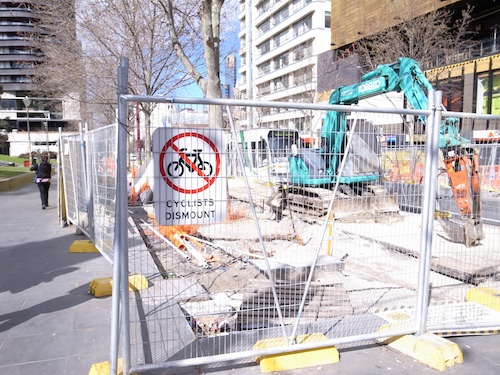
Since late May Melbourne’s primary bicycle route, Swanston Street, has been partially closed to bicycles. Swanston Street is Melbourne’s chaotic central main road. Trams and taxis fight it out with taxis, private cars, J-walking pedestrians, horse-drawn carriages, and cyclists.
The closure is due to the much heralded installation of a traffic-free and bicycle-friendly street, with large Copenhagen-style bike lanes as well as tram lanes and stops. All well and good, but after the tram tracks were relaid in three days, precious little has happened on site. Signs simply tell cyclists to dismount and proceed along the clogged footpaths.
On one ridiculously difficult commute, when the western footpath was closed off too, cyclists were directed by security to find their way North through Melbourne Central’s private labyrinth of escalators and shops. I asked the City of Melbourne what was going on and was told that I should have taken Russell or Elizabeth Streets. Not that there were any signs suggesting this detour.

Early June during a climate action rally
This is the first of several blocks to receive this treatment, and works are forecast to be complete somewhere around the end of next year. So for more than 18 months this street will not be a functioning route for cyclists. Yet it’s all apparently for them.
On the council’s webpage for the redevelopment, they state that, “Stage one closure is scheduled to occur in the first half of 2011. This means traffic in all these sections of the street will be restricted to just trams and bicycles.” Somewhere en route bicycles were cut out of the equation, at least until 2013.
Melbourne was last month elected a “bike-friendly” city, the second city on the planet to be awarded this status after Copenhagen. Perhaps the Union Cycliste Internationale didn’t visit – they should have looked at Rio instead. Less than a month later, Victoria’s Auditor General found that the state’s strategy to promote cycling as a mainstream alternative had failed. “The strategy was developed in haste without sufficient understanding of either current cycling journeys or what was required to ‘mainstream’ cycling as a form of transport.”
Saying “disappear for 19 months” to the thousands of cyclists using Swanston Street every day underlines this lack of understanding. The revamp is a long term city marketing exercise more than a solution for cyclists. A bit of lateral thought, and a less generous deadline for the contractor could have achieved both.
Bike porn:
KK RUSH HOUR FINAL VERSION from Copenhagenize on Vimeo.
27.08.11 in cities
I’ve just woke up two hours early today from a dream that may have turned into a nightmare. I was living in Christchurch. Looking around me, a sizeable chunk of Melbourne’s architects were living there too. A few trams had made the journey too. I went on one house visit. The place was a bit like one of Boyd’s tiered hillside houses, except that each tier had moved independently of the others in the earthquake. I think the experience of that was disturbing enough to wake me up. Or maybe it was the bevy of noisy architects sitting on the top level in tricky chairs. Obviously time to check out what has been happening in Christchurch since the February quake.

P.Johns, 2000
I have talked with a lot of architects, from Christchurch and not. The scale of the damage is daunting, even though is has now been dwarfed by Japan’s own catastrophe. The task ahead is immense.
Napier
Those architects in the dream remind me of something a friend said the other day. In 1931 the entire graduate architecture class at Auckland University was apparently transplanted to Napier, following the earthquake that knocked that city of 18,000 flat. Many architects went with them – my own grandfather would have but my grandmother vetoed the idea. These days Napier’s concentration of art deco buildings are the city’s main tourist attraction, and are important to the city’s sense of itself.
“The one lasting and wholesome result of that old time cataclysm, is that it made possible the building of a modern and lovely city… It acted like an annealing fire on the courage and enterprise of the inhabitants, and the matchless results of their high endeavour are on view for all beholders.”
NZ Railways magazine, Vol 1, 1935
Speed
Napier folk were aware that time was of the essence, or they would lose out to nearby Hastings. 90 year old Napier architect Guy Natusch, who was 10 during the earthquake, said last week: “In times of war or earthquakes, you’ve got to cut through that [tape] and give people extraordinary powers and trust them.” Just who will those people be?
The need for haste is questioned by M3 Architects, currently working on some rebuilding projects in Brisbane. Michael Banney recently said , “In some ways haste is the enemy. To put it in insurance terms, things are often rebuilt ‘like for like’, which is a fairly poor way to rebuild.’‘
CBD
The word from Christchurch isn’t cause for optimism. Modest insurance payouts will cause replacement buildings to be cheaply constructed. Considering that 852 of of 3691 inspected CBD buildings have been declared unsafe, and many of them formed the historic fabric of the 19th Century city, we could be looking at a city of low-rise mock-Victorian tilt-ups. And that’s just the CBD.
Delays may endanger the process too. Businesses frantic to recommence work have scattered all over the city, where they have been blackmailed into ten year leases. The rebuilt CBD of 2026 will be noticeably smaller.
The search for bodies ceased last Monday. Demolition has been in full swing since the quake, as part of the search operations. A number of intact buildings have been “taken apart” to provide safety to workers in adjacent unsafe buildings.
Some modern high-rises suffered enough damage to warrant them being demolished. Two of these buildings lost their stairwells, a rather crucial element in an earthquake. The worst off is the 26 storey Hotel Grand Chancellor, built in the ’90s. It suffered from seismic movements that pushed the building about a metre to the side and lowered parts by up to three metres. Some nasty close ups can be seen here. The building has been propped up at the foundations with mass concrete, staving off earlier intentions to implode the building by pounding it from above (somehow). It now looks like it is going to be demolished rather gingerly, piece by piece.
After rescue come rebuilding and recovery. The body in charge, The Canterbury Earthquake Recovery Authority, has yet to be officially formed. No one has yet been appointed to head the new authority. This is causing a few red faces.
Housing
After the central city media blitz, and after the international news crews had gone home, the damage to the suburbs started to receive some attention. Over 3,000 houses have been tagged for demolition, with another 7,000 expected to follow. 300,000 tonnes of silt has so far been removed from suburban properties. 70,000 have left the city of 400,000 and many others are sharing accommodation. Demand for housing has seen the Department of Building and Housing request proposals for 5,000 to 10,000 modular homes to be placed on lands being identified now.
Architects
Architects appear to have been a little absent from civic discussions about the rebuilding of Christchurch. Warren and Mahoney quickly set up a working group of architects and allied disciplines but little has been heard of their work, yet. W&M director Peter Marshall was busy fielding press calls earlier in the month though. He has suggested in the last month that, “the height of the city will drop”, echoing a common sentiment that no one would want to work in tall buildings. Interviewed in The Australian, he said that the think tank had to operate independently of government. “We can’t allow the whole process to become bogged down by bureaucracies.”
Disaster relief architectural organisations
The Auckland branch of Architecture for Humanity is working with the Unlimited State School in Christchurch to facilitate pro bono design services. They are also initiating design studios in universities around the pacific rim. More here
In the next post, when I get to it: ideas for the rebuild, and the damage done to some lesser known, but very important buildings.
28.03.11 in cities
This Fairfax video link is promotion masquerading as information. Nonetheless it is worth a look if only for the theatrical performance of garden wall guru Patrick Blanc. The topic is the Central Park development in Sydney – the Atelier Jean Nouvel building in particular.
Using a “jettying heliostat” (an array of mirrors hung out some distance from the building) Nouvel’s team is hoping to shunt light into the darker apartments – hopefully without burning holes in the curtains. They are also running gardens up the building, somehow miming Australian nature…
“The façades literally extend the park into the sky. By miming what can exist in Australian nature, we are proposing a new form of high-rise living in direct contact with nature.” Jean Nouvel
This monster development is at the old CUB site in Ultimo. As with the Melbourne CUB and QV redevelopments, the site is chopped up 19th Century fashion into several sites each being handled by a different architect. The lucky ones here are Alec Tzannes, JPW, Nouvel, and Foster.

One Central Park at night. LEDs by Yann Kersale .
30.01.11 in cities urban-planning
Taking an air-conditioned break from my traipsing about Singapore. It is relentlessly humid but hasn’t managed to rain once in the four days I’ve been here, even though there are meant to be monsoonal dumps in the late afternoon. Just as well as the umbrella is stuffed.

A new casino

Mysteriously shaped external airconditioning units at Clark Quay.

Descent into Hell at Haw Par Villa

Contrasts in Little India

Another apartment tower being built across the street. Cranes are everywhere. Despite the low wages paid to the imported Indian workforce, rents will be over SGD $5000 per month for a two bedroom flat.
And now it rains!
19.10.10 in cities
yawn
by James on 21 October 10 ·#
Not sure if you publically transcribed oscitation was induced by Singapore, or my postcard post. If the latter, I suggest you could avoid a recurrence by seeking elsewhere the stimulation required to keep you awake and entertained.
by peter on 22 October 10 ·#
boo-hoo
by James on 22 October 10 ·#

Far away from glossy houses and Adriatic naval gazing, this gritty documentary shot in the Salvation Army’s Oasis Support Network in Sydney’s Surry Hills shows a glimpse of what is like to be young, drug-addicted, and homeless in a big city.
The Oasis documentary is currently back on ABC’s iview service as a 375MB 75 minute streaming download . It was powerful enough for me to drop my long held disdain of the Salvation Army (thanks to homophobic outbursts in 1980s NZ). They will even get a donation from me.
If the ABC video has expired by the time you find this, there is a trailer here .
10.09.10 in cities

Toolern
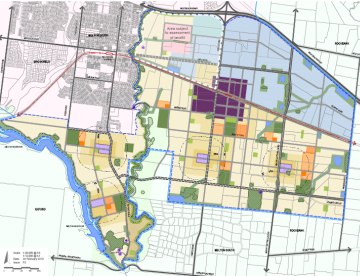
A new $15B city is to be built on the road to Ballarat. It’s called Toolern, and will plug lots of the rural gap between Caroline Springs and Melton. The new town’s footprint, if overlaid onto a map of Melbourne, would stretch from Footscray to Collingwood, and Southbank to Flemington. She’s big.

Toolern overlaid on map of Melbourne.
Toolern will have a “Major Activity Centre” at the top of the hill, about half the size of Melbourne’s CBD, which will be home to a train station and 70,000 sqm retail centre. Of the initial 30,000 sqm of retail development, one third will be supermarkets and another third big box discount warehouses. By 2026 this area will be home to 57,000 people, living in 22,000 new homes, both low and and medium density. By 2031, the population of Melton Shire as a whole is forecast to grow by 190,000 people, or 330%.
In Toolern, there will be a neighbourhood shopping centre every 1.5-2.0 km. The towns will include 18 community centres and Early Learning Centres, and eight sports pavilions. The Growth Areas Authority has many documents to view on line, and some make interesting viewing if you have the time.
For instance, how much will the infrastructure cost? The infrastructure to be funded by development contributions adds up to $177,000,000. Of that, $100,500,000 will be spent on roads, bridges and intersections. $36.2M will fund outdoor recreation, $29M community facilities, $6.3M fund public transport, and $3.8M cycle and pedestrian trails.

No mention is made (that I can find) of the cost of the services infrastructure, which is presumeably not covered by Development Contributions. Going by Rob Adams’ 2009 figures for exurban growth, the cost of services infrastructure could run to $13.2B for the Toolern housing component alone.
The plan of the new suburbs is chopped up in a similar way to most of Melbourne’s south eastern suburbs – 1 kilometre square superblocks containing mostly “conventional” housing subdivision, surrounded by 4 to 6 lane divided arterial roads. The superblocks will even be at exactly the same intervals as those in Melbourne’s South East.

at scale overlay: Toolern / Oakleigh
I had thought the superblock had been killed off decades ago, but not in practice. Superblocks and their divided perimeter roads are 70kph car-friendly suburban straitjackets. While they might make Melbourne faster to move around, they also force locals to drive short distances to get to shops and schools – it being too frightening to contemplate crossing one of these roads mid-block.

The arterial and subarterial roads are shown as double lines.
Maybe I am unduly concerned, and influenced by flashbacks of my attempts to cycle along Springvale Road (not recommended), and these new arterial roads do include off-road cycle lanes… But shouldn’t the design of a new town in 2010 investigate ways other than the hierarchical commuter road system that has helped get Melbourne into the pickle it is in? Is there anything in this plan to suggest increased levels of walking and cycling?
It has been addressed, and the result is apparently visible in the plans you see on this page. I can’t quite make out how they are different to the status quo. Booz & Co’s Precinct Structure Plan has admirable aims, and includes “off road” cycle paths (which are about 300mm off road). But that’s about it, other than some uncoordinated shared paths through green links. The authors of the Plan say ( PDF ), “these recreational paths are not expected to substitute off-road bicycle paths unless they have been designed in such way that both recreational users and commuters can use them safely and efficiently.” Is that a hint at what really needs to be done?
Adding cycle paths onto 1960s-style road systems doesn’t increase bicycle use or decrease car use. They tried this in the UK at Milton Keynes (PDF S.J. MacIntyre thesis 2006) and it didn’t really work, so why should it here?
“The Milton Keynes project illustrates the failure of well-designed bicycle infrastructure to attract cyclists, in the absence of policy measures to limit automobile use, or encourage safe bicycling. Wardman et al., support this notion, stating that, “a wider programme of transport measures than just improving cycle facilities is required for a significant modal shift to cycling”.”
“Discouragements to motorists, such as access restrictions, taxes, and other user fees, combined with increased transportation infrastructure for bicyclists can successfully shift people out from their automobiles and onto their bicycles.”
Bicycles are used for short trips mostly, not for commuting into the city on the arterial roads where the lanes are, so these cycle paths will stand empty most of the time. The few truly off road shared paths are alongside creeks and aren’t connected with where people might actually want to go. Opportunity lost?
Why the fuss about bicycles? I do bleat on about them, but so does… Maroondah City Council, who in a 2006 report on transport alternatives (PDF) stated that 40% of Melbourne car trips are under 3km. A car is at its most polluting in its first few kilometres. They say that based on their surveys, bikes could replace many of those short car trips if people felt it was safe enough to use one. 55% of home-cased car trips made in Toolern are forecast to be short local journeys.
Veitch Lister provided a transport modelling plan based on Zenith, the terribly complex Melbourne-wide transportation modelling scheme. They admit it has its limitations. It projects from a 2001 census base and doesn’t account for increased petrol prices, time-shifted commuting, increased parking charges, or changes in land use or public transportation provision. They qualify their report ( PDF ) saying that, “simply projecting historical urban growth trends into the long term future is not sufficient when analysing the impacts of major road and public transport projects…. The model makes no attempt to predict “paradigm shifts” in travel behaviour that might occur in the future. In fact the model assumes that such changes will not occur… It is not only plausible, but likely, that travel behaviour will change in the future in response to such issues as concern for the environment.” Their italics. They say in a later alternative scenario which reduces public transport and deletes the train station, and was prepared to satisfy the Department of Transport’s curiosity, that if fuel prices do increase their model ( PDF )will have, “over estimated car usage & under estimate[d] public transport usage.” Their earlier model assumes 81% of all trips will be made by car, 4% by public transport, and 16% by walking or cycling.
It would be good to see Melbourne’s new edge towns taking some steps towards future economic and environmental sustainability in their planning, rather than presume sustainability because the houses are 6 star and they’ve added a few bike lanes (marked ‘future’ ( PDF ), some high density housing, and local shopping strips.
After hours traipsing through these documents, some thoughts:

Having carved up the land, Melton Shire has put the suburbs out to the market. A developer will be announced in December. It may already be sewn up as a major developer has land interests within the area and contributed $200,000 to the structure plans.
The first subdivision for 463 homes, mostly low density, in the Western Precinct has already gained planning approval. It’s in a recently deleted Wildfire Management Overlay. Have a look at the plan and note that this is only 2% of the dwellings proposed for Toolern. She’s really big.
13.04.10 in urban-planning cities
You raise some good points here, like Melton, Toolern is destined to be another pawn in the 1969 Transport Plan, a car haven of epic Los Angeles proportions. But one glaring infrastructure problem has been overlooked – rail infrastructure. A new city of that size there without good rail and a single station is going to be crippled. According to the Victorian Transport Plan duplication and electrification to Melton is unlikely to happen until after 2016 if we’re lucky. Even with the Regional Rail link (which won’t be ready until after 2014), there is NO WAY that V/Line can cope with an extra station on the Ballarat line. Currently by the time it reaches Melton it is packed in like sardines! Ballarat and Bacchus Marsh are booming and population is growing at 2.7% and 3% annually respectively and Melton over 10%. Based on current patronage growth, the railway line will nearly quadruple its passengers by 2016. I reckon any new residents at Toolern will be bloody lucky to get on a train let alone get a seat ….
by Sean on 20 April 10 ·#
Thanks for that info Sean, it all looks a bit SNAFU. From memory, the reports don’t take into account pressure on the train line, only that there is one.
by peter on 23 April 10 ·#
agree agree agree agree dreamed about this last nite, trying to exlain to a planning minister (not justin, just a face) that it was all wrong wrong wrong. at least in toronto developers are required to build some higher desity housing, even if they do put it all in one big bldg, with a bus stop outside.
by landofoz on 3 May 10 ·#
I had no idea of this proposal, will investigate further. Great post!
$100m on roads and a mere $6m on public transport says it all. How are these highly vulnerable communities going to cope socially and economically as oil production decreases and the costs of the method of transport, around which their whole community is built, increases?
There’s no doubt that any proposed new “town” or any urban area, be publicly-owned and publicly developed. It pains me to think that there are private developers out there vying for the land upon which to construct a profitable business. Surely we, the community, people, should get the first and only say in how we want our urban form and environment to look and function.
I can’t see how anyone could trust private developers with our urban form. They will bend, straddle and side-step the rules to profiteer before they even think about the detriment their actions will impair upon people.
And what of overpopulation? This continent’s carrying capacity is supposedly only 10 million, we’re more than double over that already.
by Nick Carson on 6 January 11 ·#
Some clever chaps at the University of Padua have mapped the ancient Roman harbour city, Altinum, lying under a paddock seven kms North of Venice. The city had sunk into a lagoon, but some infra-red aerial photography during the 2007 drought was enough to tease it out. Well, after the images were fiddled with to remove plant water stress variations. This article at Der Spiegel has more fascinating images in its photo galleries, including the town’s plan, and some beautiful infra-red aerial photos of crops and cities.

And what it looks like without the infra-red specs:
Via archinect
Original source: ScienceNow
01.08.09 in cities photographers
This is the last week for public submissions about the Victorian Government’s proposed changes to the Urban Growth Boundary. You can have your say to them here, before July 17th.
Way back in 2002, the new Urban Growth Boundary looked something like this. We were assured that this would accommodate growth for 25 years. The light green areas are the green wedges, and the pink areas are the urban growth zones at the time. Positively svelte.

Back then : “The application of the UGB around metropolitan Melbourne, as provided in Melbourne 2030, will show clearly where metropolitan growth will occur and where ongoing incremental expansion will stop. As the boundary will be permanent, other than in defined growth areas, there will be greater certainty for green wedges.”
In November 2005 the “interim” boundary was extended to look like this (the dark grey areas are new urban growth areas):

Here it is again showing 2005 built up areas in grey.

In 2009 the boundary is to be extended to look like this:

The boundary goes way off the map in the North, extending to waterless Wallan. You can see a tidier version of this last map at the DSE ( PDF here ) – but strangely it is missing the 2002 boundary and the green wedges (must have forgotten them).
So we must need the space, eh? Maybe not … Dr Hugh Bradlow : “Even Los Angeles, renowned as a spread out city, has a population density which is 7 times higher than Melbourne. Take any major European or US city and you will find that it has a significantly higher population density than any Australian city.”
The Melbourne Statistical Division has a population density of 462 people per square kilometre, 1519 if you just count Metro Melbourne. Interesting to compare to the equivalent figures for Barcelona (15,825), Paris (20,775), and Jakarta (12,818). Or, in the ‘new’ world, you could look to Toronto (3,972) or Chicago (4,730).
The question forms in my head, how much is this expansion due to the lobbying of Camberwell NIMBYs and HIA / IPA spruikers, and how much is it to do with the affordable and sustainable growth of this city?
11.07.09 in urban-planning cities
The Infrastructurist mentioned a study done recently by UCLA. All had thought that the pollution effect of a freeway extended to about 300 metres downwind. Not so, pollutants spread up to 2.6 kilometres downwind, that’s a vulnerable 5.2 km belt along all our freeways. This is what it looks like for Melbourne:
In another surprise, the pollution is much worse before dawn in the Winter, despite lower traffic levels at this time of day. This is thanks to “low wind speeds and shallow temperature inversions”, says Science Daily
The researchers recommend keeping your windows closed (unless you have a toxic house?), and no jogging before sunrise! My recommendation is to move to Elwood, while it is still above sea level.
Read the full UCLA article at Science Direct (see abstract for free).
10.07.09 in sustainability cities
In a rather sprawling article The Oz tries to join the dots between the public architectural cultures of Sydney, Brisbane and Melbourne. Expert witnesses include Howard Tanner, Richard Johnson, Philip Cox, and Kim Dovey. Upshot: Brisbane is the young upstart, Melbourne’s got tickets on itself, and Sydney is resting comatose on its laurels.
04.07.09 in cities

Charles Jencks, Beatriz Maturana, and 30 or so other members of Architects and Planners for Justice in Palestine, have today sent a letter to the UK Guardian protesting an Israeli court’s recent approval for a Wiesenthal Centre Museum of Tolerance on a Muslim burial site, designed with great swoops and gushes by Frank Gehry – think worst-dressed at the 1985 Oscars. They call it an “architectural time bomb” that can only set back efforts for peace in the region.
Guardian Letters 15.11.08
Wiesenthal Centre
The Wiesenthal Centre counters that Jerusalem is an old place and every patch of land there has a history. The site is currently a four storey car park.

79 year old Gehry is celebrating this win as he commiserates over the canning of another project. His giant scheme for the Hove leisure park in Britain, based on the flowing dresses of Edwardian Ladies, has been ditched having received relentless bad press. A Save Hove spokeswoman says,“The whole thing was puffery. I’d like to see [it] refurbished, with no hoity-toity numbers, no iconic, landmark crap.”
Frank’s blistering response? “Through history, public buildings are iconic and if we want less we have no self-esteem. We might as well go back to the caves. If you add up how many iconic buildings have been built recently, how many are there? 50? 100? It’s nothing. So people can fuck off.”

All up, 2008 was a bit of an annus horribilis for Frank – Nancy MacDonald summarises it here . Gehry can at least take heart that his Art Gallery of Ontario has been mostly well-received , though fellow LA architect Ken Myers is a tad unhappy that his 1992 extensions were demolished for this one. The AGO reopened yesterday. A family medical emergency may prevent Gehry from attending the opening.
15.11.08 in architects cities
Architect / protaganist: Gehry Partners
Gehry is no longer involved with the Jerusalem project.
http://www.tabletmag.com/arts-and-culture/23575/unbuilt/
[ via archinect ]
by peter on 17 January 10 ·#
Dunedin, in Otago, was settled by the Scots in 1848. Young Charles Kettle designed a plan reminiscent of Edinburgh’s, which would make sense as the name Dunedin is derived from the Gaelic for Edinburgh. Within 13 years the city was overwhelmed by a gold rush. The small city had much golden money pumped into it, as well as a lot of Victorian bluestone (ballast in the ships from Melbourne). The population hasn’t moved a lot since those days, and the locals are wondering how to reach beyond the heavy (but beautiful) Victorian architecture that still dominates the town.
A discussion was held last week to discuss the future of architecture in Dunedin, at which writer and curator Douglas Lloyd Jenkins suggested that Dunedin was, “like Adelaide – beautiful but dying”.
Some seem to be pinning their hopes on a contentious $180M roofed Rugby stadium , that would need to be built before the Rugby World Cup in 2011. Some people aren’t happy with it at all. Sports architecture behemoths HOK are in charge – not many are in love with the design, but they do seem to have done something interesting with the transparent(?) roof:
27.08.08 in cities video-clips