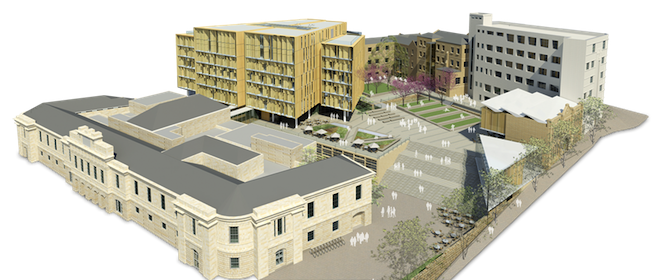
Parliament Square – original proposal (FJMT + Citta)
Six days ago, the Tasmanian government introduced a bill to remove Hobart’s Parliament Square project from the planning process, where it has been battled over since 2009 (at least). Late tonight, the fast-tracked bill was passed 10-4, according to Save 10 Murray spokesperson Briony Kidd.
The new bill removes all planning impediments and rights to appeal, and pulls all buildings on the site out of the heritage register. The bill was introduced soon after the Supreme Court, for the second time, overturned an approval handed down by the Planning Appeal Tribunal. Justice Blow said at the time that the tribunal had failed to consider “the prudence or imprudence of alternatives to [the] demolition” of 2-4 Salamanca Place. This was in response to the Planning Tribunal’s conclusion that retaining the heritage-listed Government Printer’s Office wasn’t “prudent and feasible”.

The threatened 10 Murray Street State Office Building (1967)
The new bill removes all rights of the Heritage Council to reinstate buildings to the Heritage Register under the Historic Cultural Heritage Act 1995, unless the Planning Minister is in agreement – which is rather unlikely.
The bill received support from Labor, The Liberals, Citta, The Tasmanian Chamber of Commerce, and was opposed by the Planning Institute and The Greens… and of course Save 10 Murray.
The bill states that any action or proceeding against it, or Judicial Review of it, is not permitted, by anyone. This short and hastily-written bill reads as if it has been written in a state of anger.
The renouncement of rights to object by any means to parliament’s approval of a scheme already rejected by the courts is not exactly unusual in Australia – the Victorian Planning Minister routinely does the same. This doesn’t stop it from being utterly depressing. The minimally-resourced Save 10 Murray group has been playing by the rules for three years, with a valid cause, and has now basically been told that any further noise from them and they’ll get smacked with a fine made just for them – up to $6,500, followed by up to $1,300 per day that they remain mischievous. I think it’s a sad day for Hobart, and any group there who thinks they might have the democratic right to question a development and be taken seriously.
[edited 23/11 – the Supreme Court action concerned 2-4 Salamanca Place, not 10 Murray Street, which does not have a heritage listing (it was nominated for one by the AIA but never assessed).]
THE BILL (PDF)
Supreme Court decision
Planning Institute point of view
Previous butterpaper articles
Save 10 Murray at Facebook
/~/
UPDATE 2/12/12
10 Murray Street architect Dirk Bolt’s opinion piece in The Mercury
the image of the proposed Parliament Square project currently used extensively in the media is in fact the first proposal that was rejected in the first tribunal hearing ironically because it had an adverse impact on the heritage values of Parliament House in particular and Sullivans Cove in general. Setback, height and massing changes were imposed to preserve views of Parliament House without the imposition of the new offices overbearing the symbol of Democracy….further irony as that was the principal criticism of the Ten Murray Street building…despite this circumstance being similar to many cities in Australia including Melbourne, Sydney and Brisbane.
by Paul Johnston on 21 November 12 ·#
Thanks Paul, will alter the caption. I found the image on the front page of the Parliament Square website yesterday – maybe they didn’t want to believe it was rejected?
by peter on 22 November 12 ·#
they continue to use that image and we have yet to see the revised project from the same vantage point !
by Paul Johnston on 27 November 12 ·#
That’s the subtitle of a new documentary to be previewed at Melbourne’s ACMI on August 10th, Real Estate for Ran$om. Looking into the economics of property speculation, the film’s researchers uncovered a little secret. While the REIV’s housing vacancy rate for Melbourne stands at 1.7%, the “speculative” vacancy rate, which includes housing not for rent, is 4.94%. That’s 46,220 of the 935,305 properties for which they inspected water bills – a tell tale sign of whether a house is occupied.
The survey covers 64% of Melbourne’s housing stock, assessing data from two of the three water companies (South Eastern Water did not provide useful data). The suburb with the highest vacancy rate is Docklands, for which they found 23.32% of 995 dwelling using no water or less than 50 litres per day. Carlton South has an Estimated Genuine Vacancy rate of 11.51%. Some of the figures in the 261 suburb report may be on the low side considering land-banking, and the number of older blocks of flats with a shared water bill.

The Earthsharing website says in conclusion that, “the myth of the housing shortage is being perpetuated by equating a ‘lack of housing to let’ with a ‘lack of housing’. The response from government has been to make more land available for residential development without addressing the underlying inefficient use of housing in Melbourne.”
The Age 25.07.11
Speculative Vacancy Rate Report
Real Estate for Ran$om – the film
TRAILER
Real Estate 4 Ransom Official Trailer from Real Estate 4 Ransom on Vimeo.
RELATED
China’s ghost cities at SBS Dateline
25.07.11 in planning real-estate
Big News has covered the email schemozzle to death, so I thought I’d leave it to them. But I can’t resist this screenshot from ABC TV. Masterful composition. Here is an isolated Madden looking more like Jim Hacker than he would probably like. He had just gate-crashed his way into a very important inquiry into his own department’s pants-down on public consultation. The other lads appear to be leaving him out of their chat. But what on earth has that guy on the right drawn? A legless pelvis? In confident strokes. Great work for a pollie.

ABC TV

It is with great disappointment that I look a bit closer and realise that it is not a sketch at all, but instead a pair of upturned frameless spectacles. In meetings, upturned spectacles are a sign that things are drawing to a close.
Interpreting upturned glasses as a limbless pelvis means I should probably take the rest of the weekend off.
13.03.10 in planning weird-wonderful
fair enuf,
i wanted to believe it was a sketch of a dick head.
by hairdresser on 13 March 10 ·#
The marxicans should admit that this is the final proof of being 25 years behind Queensland.
by luke on 14 March 10 ·#
only 25 years? – justines an 80s rimmer.
famous 4 doing all his projects with texta on sorbent.
http://www.monash.edu.au/news/newsline/story/1282
anyone know if justine is registered or AIA member?
by hairdresser on 14 March 10 ·#
by peter on 14 March 10 ·#
thanks ^
hackoutant obviously plays hard on party donations.
by hairdresser on 14 March 10 ·#
There have been some outstanding graduates come from the Emperor’s Cooking Academy over the years.
by luke on 14 March 10 ·#
reading that email^
strong links btween essendon fc/supporters and 2 gens of labour govt. still strong.
by hardresser on 14 March 10 ·#
by peter on 15 March 10 ·#
irrespective of architectural issues – Madman is still a Carton hero …. surely that is enough?
by luke on 19 March 10 ·#
john helliot also believed he wosn’t a crim.
by hairdresser on 20 March 10 ·#

click for larger
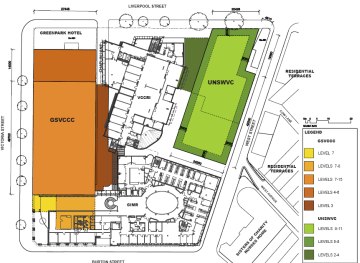
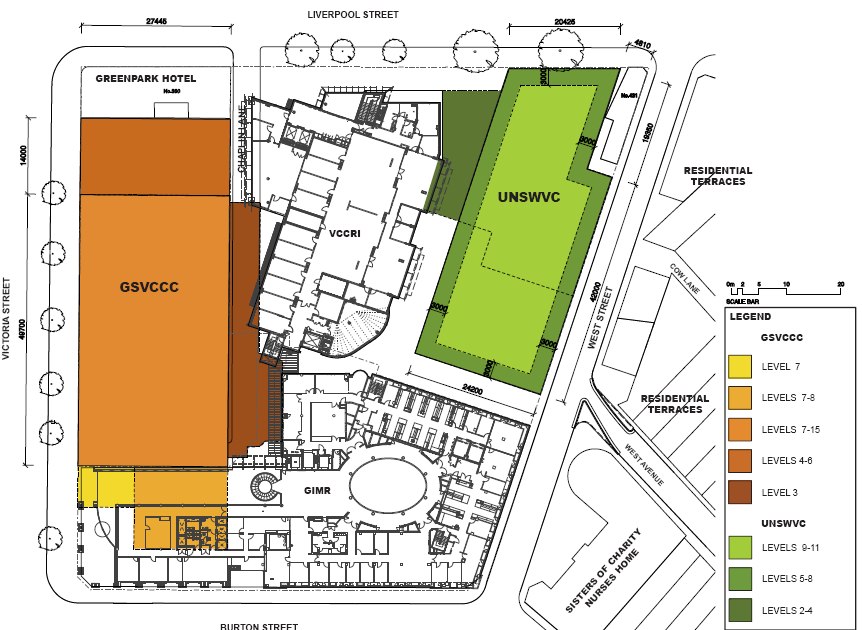
You’ve probably seen around the net news that the City of Sydney has submitted an “alternate” plan for the Garvan St Vincent’s Cancer Centre and UNSW Virology Centre in Darlinghurst, Sydney. This is an area familiar to most Sydneysiders as one happily littered with small houses and eateries. The CoS thinks the new buildings are too big and are advocating that they be made smaller by leaving out the UNSW Virology Centre and stepping back a lower Cancer Centre from the street frontages.
The BVN design for the Garvan Institute is admitedly massive for the site and locale. There are no available architectural renders for the Daryl Jackdon + Robin Dyke UNSW Virology Centre, though it looks pretty bloody big in the massing model further down.

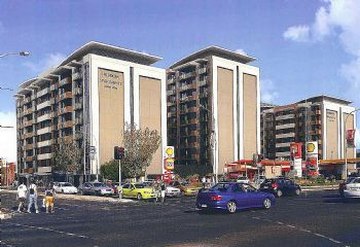
BVN render from Victoria Street – North.

BVN render from Victoria Street – South.
Councils are normally hamstrung and hand-wringing in such situations, as the approval for major projects comes not from them but from the state government. Still it is unheard of (I may be wrong) for a council to submit an alternative proposal.
Lord Mayor Clover Moore has spoken out about the designs, saying they disobey a 2005 masterplan, are excessive, have too many carparks, and fail to meet sustainability benchmarks. The CoS submission states that the overshadowing diagrams “lack credibility”.
Massing montages of the West Street proposal for the UNSW Virology Centre follow.

Urbis + DJ massing model from West Street.

CoS’s prefered mass from Victoria Street.
View Larger Map
What’s there at the moment.
Looking at the apparently credibility-lacking shadow diagrams, I wonder how BVN could have made them any harder on themselves. Here is the June 21 9a.m. diagram, casting shadow over a cafe-strewn area currently bathed in morning sunlight.

BVN shadow diagram drawn 24th April, 2009.
The following is from the series that Clover believes lack credibility. The orange smudges represent new shadows, and are pretty thin on the ground. The sites slope to the East and there are other tall buildings in the vicinity, so it is hard to verify the diagrams. But why would they be faked?

Urbis shadow diagram for both buildings, June 21, 3p.m.
Arup’s ESD report for the BVN proposal ( PDF ) is dotted with escape phrases such as “will consider” and “will investigate”, but does (more or less) commit to being in the top 25% when gauged against the American Labs 21 benchmark. It doesn’t refer to any particular architectural innovations on the ESD front, but perhaps that is a big ask of a tightly-packed laboratory building.
Please comment below if you know anything more or have an opinion on this complex affair. Should St Vincents be allowed to gobble up Darlinghurst or should new buildings step down to a scale more in tune with the neighbourhood? Has Clover stepped out of bounds, or did someone need to? Should the architects just fill the envelope given to them, or question it?
30.08.09 in buildings planning
As a non architect, I dislike the idea of councils or politicians commenting on work that is not designed for or paid for by them. Councils restrict new design enough- any more and there will be no innovation. We’ll end up with bland boxes that fulfill size criteria, and hide from their surroundings. But in Darlinghurst etc the surroundings are not that great- the “heritage” is really just old- so some change would be welcome?
by will on 31 August 09 ·#
The practice of councils doing their own work is more common than you would think. I was the Senior Urban Designer at the CoS for 3 years & when there are the resources to do this, councillors feel more empowered to push against proposals that are submitted by applicants. I’ve also had councils commission other architects to come up with alternatives for my own design work (Hunters Hill) which I find an even greater irregularity. There is a great deal of suspicion about the accuracy of design proposals especially when it comes to mass and sun-shading impacts. Sometimes its warranted but mostly its designed to give the politicians some leverage over the work & be seen to be actively meeting their constituents’ interests. What is discouraging is that the people making these critical assumptions are working to a reactive political framework rather than one that is design led.
The first picture looks uncannily similar to the new Myer building at Melbourne Docklands. Then the second photo looks like it accidentally collided with Hosies Hotel. 1950s architects would be immensely satisfied that their somewhat ideas are being resurrected half a century later.
I think it is fine if council’s put up alternative proposals if it adds to the debate on a contentious development. In this case there was widespread community opposition to a massive building that materially impacted the adjoining urban environment. The proposal violated an earlier masterplan that the community had pushed for to get certainty over development forms – and which was presented to the community but was not submitted for approval with the State government. The end result is a hodge bodge of buildings with massive density, poor intergration with adjacent areas, and significant environmental impacts. The CoS proposal highlighted an alternative that needed to be articulated on behalf of the community given the tick a box approach to community consultation adopted by the applicant.
by Blake on 22 December 11 ·#
Adelaide Now reports on two developments in a spot of bother, both for being out of character. The first is a Jetsonesque building by DC Architecture in Kent Town, which despite being approved by State Heritage and the Council, and despite being made less space age and more stone age than the pic below shows, was recently knocked back by the local Development Assessment Panel for reasons including:
LINK to DAP minutes. (PDF, pg 99)
The council (which supported the proposal) also said that the DAP had, “fundamental concerns with the residential nature of the development.”
Pic of original proposal by DC:

Google Street View showing a bit more of the neighbour, with approved heritage bling.
View Larger Map
Meanwhile over on the Semaphore beach front, developers Nikolas Anargyros and Grafio Pty Ltd have to pay $39,000 plus legal costs of $56,000 for de-blinging their building, at variance to the design approved by Council.
This one has been in and out of the courts for the last three years since the duplex was built. The council had been wanting the front pulled off and changed to something more historic, with eaves gutters and gables, like they had approved. They won’t get that now, but will get some cash instead.
One might have hoped that the developers went for something a little less bland in their transgression – like Giuseppe Terragni did in Como in 1927, when he presented a traditional building to council for approval, then proceeded to construct Novocomum behind the scaffold screening.
A&D have spoken to DC architects about the project. DC are taking it to court, and say, “This is a massive problem for architecture in Adelaide. It’s difficult enough for architects to come up with good designs without having them be trampled over by council.” I thought it was the DAP that was the problem here?
by peter on 1 September 09 ·#
The state branch of the ®AIA has protested the rejection of the second DC proposal, asying it isn’t in tune with the 30 year plan. State president Timothy Horton: “This shouldn’t be seen as a sacrifice we need to make but an opportunity we need to grasp.”
ADELAIDE NOW
by peter on 6 September 09 ·#
An Albert Park resident is having the usual problems trying to demolish his “bog standard” deco house, and has gone to the press with it as consultant fees top 150K. “When we’ve put extensions to [the council] previously they said they didn’t like architecture that mimicked previous periods… Then we bring in a contemporary design and they say it introduces new elements. I thought they were a bunch of megalomaniac tossers.”

Adelaide architect Fred Phillis has complained about the Adelaide Development Assessment Panel after they turned down his application for three student housing towers on Grote Street with a few choice phrases that didn’t make it into the minutes , but ended up in the paper … such as “absolute rubbish” and “future slums”. Adelaide council has warned the DAP to behave itself: “Mr Phillis has requested an apology and that the relevant panel members be removed from office… The council takes any such complaint seriously. This complaint serves as a reminder to you and your duties of public office… In particular, that as a member of the panel, you are expected to act with integrity and professionalism.”
The functions of the DAP include , “as it thinks fit, to provide advice and reports to the council on trends, issues and other matters relating to planning or development that have become apparent or arisen through its assessment of applications under [the relevant] Act.”
07.06.09 in planning
Bloody funny. Judging from the picture, they do have a point. A sharp tongue should be a prerequisite for any assessment panel, a shame they were too soft to put that ‘feedback’ in the minutes. Instead of kicking them off, they should be honoured.
Been enjoying the updates Peter, cheers.
Fred should know better than submit something so far outside any reasonable plan, it lacks parking, aesthetic merit and impossible to evacuate in an emergency let alone the number of lifts for daily use.
It was lodged like an ambit claim than an honest proposal. He deserves the kicks
by David on 9 June 09 ·#
Denton Corker Marshall is working with the Halim Group on a design for a 15 storey tower behind the historic Windsor Hotel. The tower will reportedly wipe out part of the Hard Rock Cafe – no great loss there. But the National Trust isn’t happy – CEO Martin Purslow saying, “This proposal is over twice the statutory height limit under Melbourne’s planning scheme. It says the statutory height limit is to preserve the scale of the Bourke Hill precinct, and that’s the bloody reason we have these limits.”
A two week public hearing starts next week into the fate of several sites very close to Melbourne’s Shrine of Remembrance.
It has been a sorry saga. In 1999, someone somehow omitted to transcribe a height control for these St Kilda Road sites to the reformatted planning scheme. The height control of 36m above AHD (25m above street level) vanished.
Oops there’s a gap:

In 2000 Overland Properties Pty Ltd purchased 324 to 332 St Kilda Road, and in 2007 visited the council for a pre-application meeting for their 160m tall tower, designed by neighbours SJB. It would overshadow part of the Shrine and many were not too happy about that.

Surprised planners set out to fix the error by recommending an immediate amendment to the law in June 2007, requesting that the Minister for Planning use special powers to carry it through immediately without public examination. Council instead deferred the matter.
In December 2007, after much dialogue with the developers about the need for high design standards and ESD on such an important site, council proposed an amendment to the planning scheme for a 60m height limit to the area, with a 25m podium. In July 2008, 81 objections later , council reverted back to 36m as its preferred height and requested the Minister approve this pronto – Overland had just lodged a planning application for a 112m high mixed use building and they needed to respond.
Instead of implementing the council’s recommendation, Minister Madden called the project in , saying that it could not be resolved using normal processes.
A public hearing will begin on March 23rd.
The existing 7 to 8 storey buildings on the site:

I was just sent the link to this hilarious but rather old article from last May – about an architect who seems to have snapped while writing a planning report for a farm shed somewhere in the UK.
An example, Context Analysis: “The use is compatible with a farm because it is a farm building… It is located where it is because it is in the most convenient place, being on the farm and near the farmhouse.”
Council accepted the report, and noted that it covered all clauses: “As long as the architect answers all the relevant headings then it doesn’t really matter what the tone of the application is.”
This website advises you not to try this at work – but if you can’t resist, send us an excerpt or two.
UK Telegraph 06.05.08#
tip M.E.
22.02.09 in weird-wonderful planning
City of Yarra
by ben on 24 February 09 ·#
The renowned and quite deceased New Zealand architect William Gummer, as a young architect, participated in the competition for the planning of Canberra. The plan on this linked page can be viewed at a much larger scale if saved first then opened. The full text of the entry is included, and includes this little statement that suggests that competitions were the same mad dash then as they are now.
It is the architectural idea which will secure the required beauty, dignity and grace to the City and thus the greatest amount of work has been given to the subject. Unfortunately time was too short to give the results adequate expression by means of drawings and sketches.

01.04.08 in planning
Architect / protaganist: Gummer and Ford