Drew Carling and Jenni Draper report from the US pavilion, which has just opened at the Venice Biennale.
Spontaneous Interventions: Design Actions for the Common Good
United States Pavilion
13th International Architecture Biennale, Venice
Spontaneous Interventions displays the shift in urban design thought away from centralized policy making towards optimistically empowering citizens to find ways of improving their own urban environments. It highlights citizen-led alternatives, from guerilla bike lanes to reclaiming outdoor lounge rooms, and often questions existing municipal by-laws. The curators have further liberated this expression by featuring for the very first time in the history of the US pavillion an installation (as opposed to conventional exhibition of projects) which in the American way is done by system of banners which hang from the pavilion roof. These banners though are manually activated via counterweights that connect back to adjacent walls.
The banners (124 in total) archive both the selected actionable tactics to improve the urban realm but also suggest on their opposing face a semantic color code of coloured stripes which reflect the desired outcomes of these tactics and vary in width according to their weighted outcomes. The dominant desire overall generally being that of fostering a better community. The counterweights are labelled with the “burden” that the urban tactic is attempting to mitigate, and when moved displays the new optimistic outcome.
The result is in line with the biennale’s general theme of a common ground of thought or activism but it also displays a collective field of colour which retains its overall unity through this coding and to which Cathy Lang Ho (commissioner and curator) so boldly suggests could even go so far as creating a new iconography for the United States.
31.08.12 in exhibition

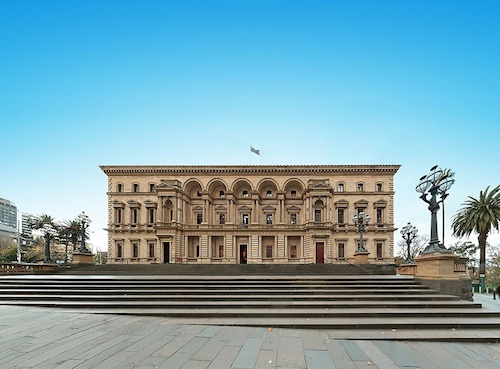
[ Old Treasury Building, Melbourne. Gil Meydan ]
A young John James Clark arrived in Melbourne in the early 1850s with his family, emigrating from Liverpool. At the age of 14, he visited the Colonial Architect’s Office with a map of Liverpool he drew for school. He was hired and there began a six decade career in architecture.
Andrew Dodd recently released a book on Clark, based on his PhD. Its launch coincides with an exhibition being held at Clark’s master work, the Old Treasury Building, designed when he was just 19.
Having looked through the newspapers of the time, Dodd was unable to find anything to suggest that anyone thought it odd that such a young man would gain such a commission. He suspected this has something to do with the exodus of skilled professionals from the city to the gold rush up the road. But there was also a different attitude towards youth…
“We were talking about a period when young people were given many more opportunities than they are today.”
To hear an interview with Dodd on By Design, go here
For exhibition details, click here
To purchase Dodd’s book at Readings, click here
For a gob-smackingly impressive list of Clark’s work, click this.
20.05.12 in exhibition heritage
Students from the VCA & RMIT & Swinburne have conspired to put together a pop-up “pirate” radio tower in Southbank, Melbourne. Designed by U.S. architect of things containerised, Adam Kalkin, with possible allusions to Sydney Nolan’s Ned Kelly, the tower is made from several old shipping containers. It’s covered in a camouflage design, but I think the authorities will spot it. It’s all part of the Ian Potter Museum’s Mis-design exhibition. “Mis-Design conceives of and affirms a future for art, outside of the art world, as a parasite in the complex machinery of consumer culture.”
Pirate Radio Tower
Adam Kalkin
Photo Gallery
mis-design

22.07.11 in exhibition radio
Cate Blanchett going on like she’s at Pecha Kucha. I think she (and creator Nathan Coley) might be trying to take the piss out of us!
This lecture forms part of ACCA’s Nathan Coley exhibition (finishes on the 24th).
ACCA’s large exhibition hall will be transformed into a civic plaza, defined by a series of cast concrete platforms in situ, inspired by designs of Oscar Niemeyer for Brazil’s iconic modernist capital city, Brasilia.
More here
19.07.11 in weird-wonderful exhibition
The Hansen Yuncken exhibition at Melbourne Uni has been extended to the 24th. MORE

07.12.10 in exhibition
How could the lobby of RMIT be one of its achievements?
by nelle on 21 December 10 ·#

It must be the end of the year, as RMIT’s INDEX is about to launch in a sprawling woolstore in a forgotten corner of North Melbourne, down where all the landlords seem to make most of their dough erecting massive billboards on their buildings for the enjoyment of passersby on the Tullamarine tollway.
Moderne and colourful 64 Sutton Street was designed for the Commonwealth Wool and Produce Company by WJ Grassick in 1934. The Index catalogue says, “Under the new ownership of the The University Food Group a diverse range of industries, businesses and creative’s now occupy the maze like interior of the building.”
INDEX is an exhibition of thesis projects by RMIT’s graduating interior design students. They have a pretty good opening bash too. Could be worth a detour.
Mr Grassick was known about town as a designer for the Coode Island airport, Ford Geelong, and the deco building in North Melbourne that used to be the Sussan HQ. Will Grassick attempted to register as an architect with the recently formed registration board in 1923, supported by Alec Eggleston and Harry Tompkins, but was rejected: “you do not possess the necessary qualifications”.
SIMON REEVES’ GRASSICK PROFILE AT BUILT HERITAGE (PDF)

10.11.10 in exhibition
Oops. The first pic is the wrong building. I was about 100m out. Apologies to Mr Grassick.
by peter on 2 December 10 ·#
The Phooey ‘Upcycle’ exhibition is closing tonight – with drinks.. erm… right now. It is/was at the Wunderlich Gallery at Melbourne Uni. For those how didn’t get there, here I some phone cam shots I took yesterday. The entire exhibition is printed on old carpet tiles, and covers the floor and wall of the gallery. There is nothing in the gallery space expect for visitors looking like giants walking over small buildings. Considering the less-than-pristine state of the carpet tiles, it is interesting to see how well the images have printed onto them – they are quite high resolution. IT was easy to become emersed in the little scenes scattered around the room. Quite a pong from the paints and glues hung in the room, which may have had an effect on my state of mind.


Oh dear, now I’m late.
01.10.10 in exhibition
Architect / protaganist: Phooey Architects
Shumi Bose at Urban Omnibus walks us through the exhibits at the Venice Biennale. Despite Seijima’s theme being “People meeting in architecture”, Bose found that, “the consideration of people and experience of architecture was pretty remote from most of the exhibits.” For Shumi, the Romanian pavilion won, with its Bellini-at-the-NGV skewed box in a box.
Bahrain have won the Golden Lion for best national participation for their look at their own changing coastline.
ADR
I’ll add to this with some other reviews I’ve found but misplaced due to a change of computer.. so scroll down for them in the future.
The future:
Wall Street Journal
Architects, critics, engineers, urban planners, academics and design fans trudge from pavilion to pavilion through the dusty gravel and punishing heat, sweltering in their emphatic eyewear and their black designer suits so unsuited to the heat, their T-shirts emblazoned with the names of typefaces (in those typefaces), acquiring more and more cloth tote bags packed with catalogues and manifestos as they go..
08.09.10 in exhibition
Just a reminder that the Australian exhibition (curated by John Gollings and Ivan Rijavec) at the Venice Architecture Biennale opens on Thursday. From the list of winners, it could be good. I will be keeping an eye open for images from Venice so we can pretend to be there.

ABUNDANCE 2008 (PJ)
Having attended in 2008, rather accidentally, I was impressed at the breadth and depth of the Biennale. It took two days to trek through and my head was spinning at the end – though that may have been due to the lack of reasonably priced food. And admittedly a good chunk of that time was spent fixing Antarctica’s model in the Australian pavilion – it had slumped a bit as it was shipped through the tropics – these new-fangled resins are meant for the cold countries.

HOTEL POLONIA 2008 (PJ)
My favourite country exhibit at the time was Poland’s Hotel Polonia , which gives new functions to interloping foreign-designed office blocks once the economy collapses. This year’s Polish entry looks no less interesting.
“The installation Emergency Exit by artist Agnieszka Kurant and architect Aleksandra Wasilkowska seeks to go beyond the logic of urban reality through the creation of ‘urban portable holes’: in-between spaces, places of uncertainty and doubt, of time-space discontinuity, such as abandoned or unfinished buildings, sites of catastrophe or accidents, illegal markets, rooftops and tunnels.”
24.08.10 in exhibition

Title’s a bit obvious I know. It’s been a long week. In 2004 Federation Square allowed momentary graffiti to be projected onto one of its shards. Now we can do it all again – plot your painting here .
Image: A wave of calm swept over the city, by Cat Martin.
04.06.10 in exhibition